How to Play Chicken Hot Run
Chicken Hot Run takes about thirty seconds to learn and rather longer to play sensibly. The rules are short, the decision is always the same one, and almost everything that separates a calm session from an expensive one happens before you press play. This guide covers the mechanics as they are written in the game rules, then the part the rules do not cover: how to make the one decision the game hands you.
On This Page 7 min read
The Rules in One Minute
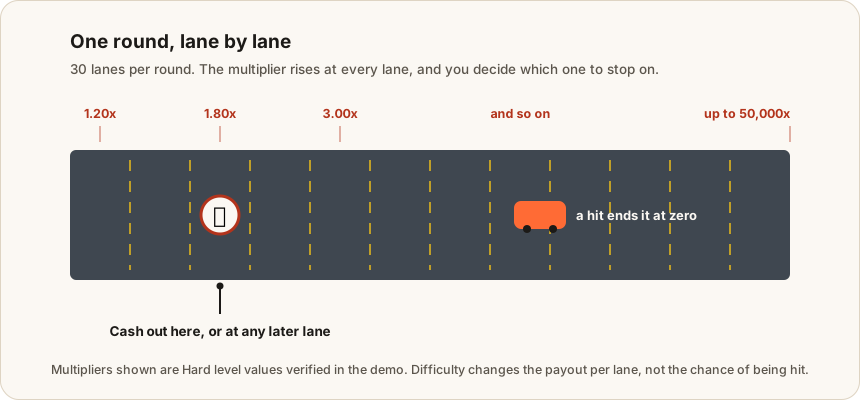
A round has 30 lanes. You set a stake, choose one of three difficulty levels and press play. The chicken steps from lane to lane, and the running multiplier grows at each one. At any point you can press cash out and take your stake multiplied by the value of the lane the chicken is standing on. If a car reaches the chicken before you cash out, the round ends and the stake is lost in full. There is no partial payout and no consolation prize.
What Difficulty Actually Changes
The game rules state it plainly: the number of lanes and the chance of being hit are the same on every level. Difficulty does not make an individual step more dangerous. It changes what you are paid for taking that step, and how high the ceiling sits.
| Level | First five lanes | Ceiling | What it means |
|---|---|---|---|
| Easy | 1.02x · 1.04x · 1.07x · 1.10x · 1.15x | 50x | The opening lanes barely clear your stake, so a payout worth taking sits deep in the run. |
| Medium | 1.05x · 1.15x · 1.30x · 1.40x · 1.50x | 25,000x | A middle setting: the multiplier builds fast enough to matter within a handful of lanes. |
| Hard | 1.20x · 1.50x · 1.80x · 2.25x · 3.00x | 50,000x | You triple your stake by the fifth lane, and the headline ceiling sits far beyond that. |
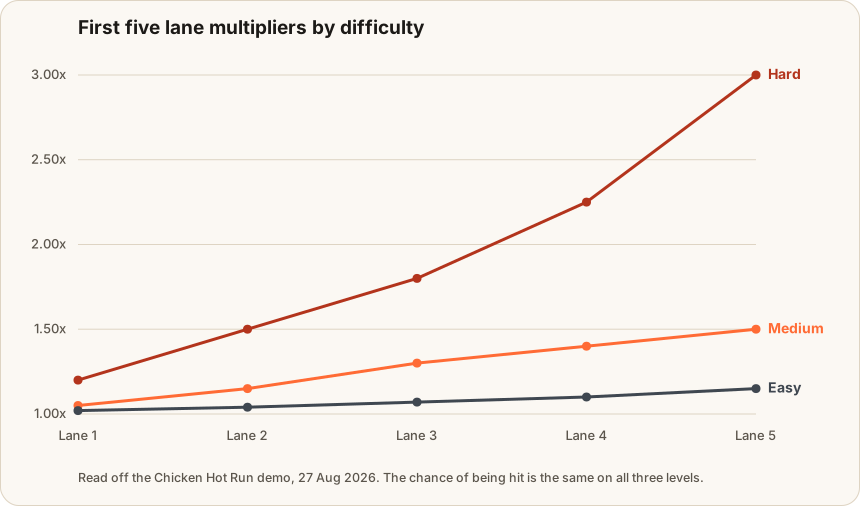
The practical consequence: on Easy a payout worth having sits deep in the run, so you are exposed to many steps to earn it. On Hard the same number of steps pays far more, which is why the level feels generous early and punishing later. Neither level is safer per lane. Only the price of a lane changes.
Choosing an Exit Lane
There is exactly one decision in this game, and it is worth treating it seriously: which lane you stop on. Decide it before the round starts. Once the chicken is moving, every lane it survives makes the next one feel more owed to you, which is precisely the moment judgement gets worse.
A workable habit is to pick a lane number, play a fixed block of rounds at it without changing your mind mid round, and only then compare. The multiplier you did not collect is not saved for later. Each round starts from zero regardless of how the last one went, and the game keeps no memory of a near miss.
Deciding Before Versus Deciding During
Pros
- The exit lane is a number you chose while calm, not while watching the chicken move.
- A block of rounds at a fixed lane tells you something about the game, because nothing else changed.
- Losing a round costs exactly what you planned it to cost.
- Cashing out early stops feeling like a mistake, because it was the plan.
Cons
- Deciding mid round means every surviving lane argues for one more.
- A single deep run rewrites your sense of what is normal.
- Chasing the lane you almost reached last round is how a fixed stake quietly grows.
- Nothing you learn this way is comparable, because every round used different rules.
Bankroll and Stake Size
Cash-out games carry a psychological trap of their own. Every lost round teaches you one more lane that you almost reached, and that nudges you to stretch the next one. It is exactly backwards from what helps.
- Decide the exit lane before you press play, not during the round.
- Keep the stake flat and small relative to the money set aside for the session.
- Decide how many rounds you will play in advance, and stop there whatever the result.
- Stay on Easy or Medium until you have a feel for how far a run typically gets.
- If you switch autoplay on, lower the stake to match, because the round rate goes up.
A note on the numbers in the demo: the 500 to 10,000 PTS range is play money with a fictional balance. It is not a currency and it is not the real-money betting range you will meet at an operator, since those limits are set by each casino.
Autoplay and Round History
Autoplay repeats your settings at a faster pace. It improves nothing about the odds, and the one thing it multiplies reliably is spend per minute. In a game where the entire skill is deciding when to stop, automating the round hands away the only part that was yours.
Round history is more useful, and underrated. It shows how your fixed exit lane has actually performed across a block of rounds, which is a far more honest picture than the memory of the one run that went deep. The reality check timer is worth switching on for the same reason.
Common Mistakes
Treating Hard as "more risk"
The chance of a hit does not change by level. Hard pays more per lane and puts the big multipliers further away, which is a different thing entirely.
Reading 50,000x as a target
It is the ceiling of the Hard level, in the same way a jackpot is the top of a slot paytable. Every extra lane compounds another chance to lose the round.
Quoting an RTP you found somewhere
The studio does not publish one for this title. A number without a source is not data, whatever site it appears on.
Believing in hot lanes
Rounds are independent. A lane that paid three times in a row owes you nothing on the fourth.
Practise in the Demo First
Fifty rounds cashing out at the same lane will tell you more about this game than any multiplier table, and in the demo it costs nothing.
Play money only. Use it to measure your exit lane before any of this involves real money.
Play for Real Money
Written by Tasho Tashev
Crash & Instant Games Editorial Author
Tasho Tashev writes about crash and cash-out game mechanics across an independent portfolio of game guides, working from provider help screens and hands-on demo sessions rather than second-hand figures. On this site he covers Chicken Hot Run by Expanse Studios.
Frequently Asked Questions
How do I cash out?
Press the Cash Out button at any lane. You are paid your stake multiplied by the value of the lane the chicken is standing on. Wait too long and a car ends the round with nothing.
Is there a strategy that beats the game?
No strategy changes the odds of any single lane, because those odds are fixed and constant. What you can control is the exit lane you decide on before the round starts, your stake size and how many rounds you play. That is bankroll management, not a winning system.
Does autoplay improve results?
No. Autoplay repeats your settings faster, and the only thing it reliably multiplies is your spend per minute. In a game where the whole skill sits in deciding when to stop, automating it hands away the one part that was yours.
Which difficulty should a new player pick?
Easy or Medium while you learn the rhythm of the game. On Easy the first lanes barely clear your stake, which is a cheap way to see how far a typical run reaches before you raise the stakes on Medium.
Can I play on a phone?
Yes. The game runs in the browser on both mobile and desktop, and the demo on this site works the same way on either.
Know the Rules? Try a Round
Start with the free demo, no signup or deposit needed, and decide your exit lane before you ever play for real money.
This is an independent editorial site, not a casino operator. 18+ only. It carries affiliate links, see the disclosure in the footer.